CLP Label Printer Checklist: New Font Rules From 2027
From 1 January 2027 a hazard label is only compliant if the text on it is physically big enough. Regulation (EU) 2024/2865, the revision of CLP, puts minimum font height, minimum pictogram size, minimum line spacing and minimum label dimensions into Annex I as hard numbers. Most producers are treating this as a graphic design job and sending the artwork back to a studio. It is also a hardware job: a 203 dpi printer, a 100 mm wide roll and a wax ribbon will fail the new label before the artwork is even approved.
This is the checklist we run with chemical blenders, paint and coating producers, cleaning product packers and laboratories across the Baltics, Finland, Poland and Czechia. It maps the regulation to the printer, the media and the ribbon you actually have to order.
Which CLP label printer should you order for your container sizes?
| Your situation | Order this |
|---|---|
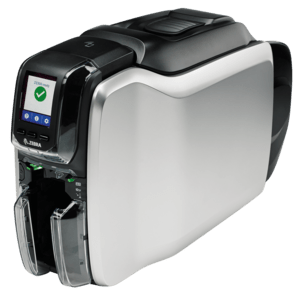
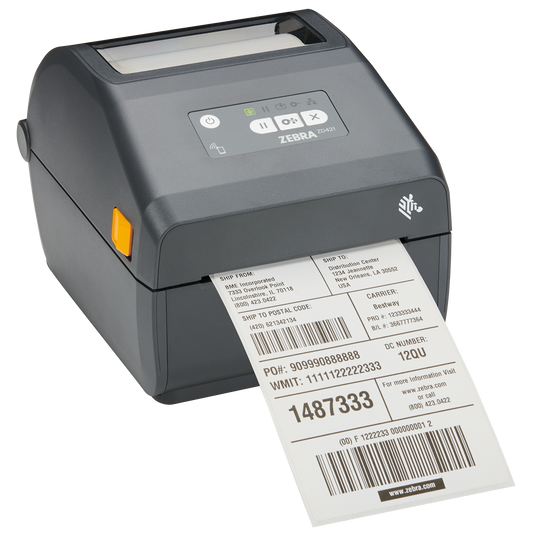
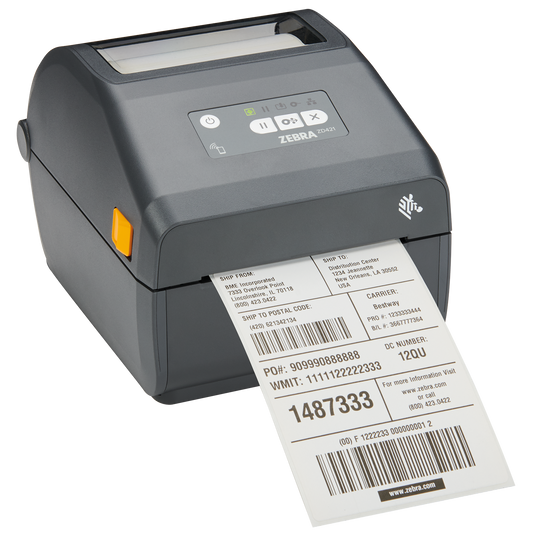
| Bottles and tins up to 3 litres, pre-printed red-diamond stock | Zebra ZD421t 300 dpi desktop (ZD4A043-30EX02EZ), from 567.78 EUR |
| Mixed sizes up to 50 litres, a few hundred labels a shift | Zebra ZT231 300 dpi (ZT23143-T0E000FZ), from 809.86 EUR |
| Filling line, 3 to 500 litre drums, black onto pre-print | Zebra ZT411 300 dpi (ZT41143-T0E0000Z), from 1326.21 EUR |
| IBCs and containers over 500 litres, so 148 x 210 mm labels | Zebra ZT421 300 dpi, 6 inch (ZT42163-T0E0000Z), from 2658.67 EUR |
| Blank stock, red diamonds printed on demand, up to 104 mm wide | Epson ColorWorks C4000 (C31CK03102MK), from 1832.69 EUR |
| Blank stock, full colour, labels wider than 110 mm | Epson ColorWorks C6500, 8 inch (C31CH77102), from 3613.31 EUR |
| Under 50 labels a day, pre-printed stock, tight budget | Honeywell PC42E-T 300 dpi (PC42E-TB02300), from 282.43 EUR |
What exactly changes, and when?
The revision entered into force on 10 December 2024 and phases in. Two dates matter for the label itself, and each has a separate transitional period for product already sitting in the supply chain.
| Date | What applies to new product | Stock already on the market |
|---|---|---|
| 10 December 2024 | Regulation in force. Fold-out labels allowed for packaging of any size. Digital labelling framework under Articles 34a and 34b. | Not applicable |
| 1 July 2026 | An EU or EEA supplier must be identified on the label. New label update deadlines: 6 months when a hazard class is added or the classification becomes stricter, 18 months for other changes. | Until 1 July 2028 |
| 1 January 2027 | Physical label characteristics: minimum label dimensions, minimum font height, minimum pictogram size, line spacing, sans-serif typeface, black text on white. | Until 1 January 2029 |
If you are reading this in late 2026, the deadline that changes your hardware is eleven weeks away, and lead times on 6 inch industrial printers are not short.
Which label size does your container force on you?
Annex I sets the minimum label area and the minimum type size by package capacity. Font size is specified as x-height, the height of a lower-case x, not as a point size. Line spacing must be at least 120 per cent of the font size, and each pictogram must cover at least one fifteenth of the label area reserved for the mandatory information, with an absolute floor of 1 cm squared.
| Container capacity | Minimum label size (mm) | Minimum pictogram (mm) | Minimum x-height (mm) |
|---|---|---|---|
| Up to 0.5 litres | 52 x 74 where possible | 16 x 16 where possible, never below 10 x 10 | 1.2 |
| Over 0.5 up to 3 litres | 52 x 74 where possible | 16 x 16 where possible, never below 10 x 10 | 1.4 |
| Over 3 up to 50 litres | 74 x 105 | 23 x 23 | 1.8 |
| Over 50 up to 500 litres | 105 x 148 | 32 x 32 | 2.0 |
| Over 500 litres | 148 x 210 | 46 x 46 | 2.0 |
Read the last row again, because it is where most installed printers stop. A 148 mm wide label will not come out of a 4 inch printer. The print width on a 4 inch industrial machine is 104 mm and the media path takes about 114 mm. For IBCs, 200 litre drums labelled at full size, and anything above 500 litres, you need a 6 inch class printer such as the ZT421, or the 8 inch colour inkjet route. There is no firmware setting that fixes this.
Why 203 dpi fails a 1.2 mm x-height in Estonian, Latvian and Czech
A 1.2 mm x-height sounds trivial until you convert it to printhead dots.
| Print resolution | Dots per mm | Dots in a 1.2 mm x-height | Dots in a 2.0 mm x-height |
|---|---|---|---|
| 203 dpi | 8.0 | 10 | 16 |
| 300 dpi | 11.8 | 14 | 24 |
| 600 dpi | 23.6 | 28 | 47 |
Ten dots is the entire body of the letter. Ascenders, descenders and the gaps between strokes have to fit around it. At 203 dpi a lower-case e at that size closes up and a rounded letter picks up visible stair-stepping, which is exactly the legibility an inspector is looking at.
Then add the languages. A product sold in Estonia, Latvia and Lithuania needs the hazard and precautionary statements in all three official languages on one label. Estonian, Latvian, Lithuanian, Polish and Czech all stack diacritics above the x-height: the caron on c, s and z, the acute on a, e and o, the ogonek below a and e, the macron on Latvian vowels. Those marks need their own dot rows and their own clear gap. At 203 dpi there are not enough rows left, and a caron merges into the letter below it or disappears into the next line, which the 120 per cent line spacing rule tightens further.
The practical rule we give: 300 dpi minimum for any CLP label in a Baltic, Polish or Czech language, and 600 dpi if you are putting three or more languages on a container of 3 litres or less. Every printer in our GHS and CLP label printer range is listed with its resolution so you can filter on it.
How do you print the red pictogram border?
A hazard pictogram is a black symbol on a white background inside a red frame wide enough to be clearly visible. A monochrome thermal transfer printer prints black. That leaves two honest options.
Pre-printed stock plus a mono printer. You buy label stock with the red diamonds already flexo-printed, and your thermal printer drops the black symbol, product identifier, statements and supplier block into the blank areas. Cost per label is low, print quality of the red is excellent, and a 300 dpi desktop printer at under 600 EUR does the job. The trade-off is inventory: you hold a separate pre-print for every combination of label size and pictogram count, and a classification change can turn a pallet of stock into waste.
Blank stock plus a colour printer. An Epson ColorWorks prints the frame, the symbol and the text in one pass on plain white synthetic stock. One roll covers every product. Pigment inks on the ColorWorks range are water and smudge resistant, which matters on a container that gets handled wet. The trade-off is the machine price and the ink cost per label, so this pays back when you run many short runs rather than few long ones.
The honest version: if you make four products in two sizes, pre-print is cheaper and you should not buy a colour printer. If you blend to order and your label artwork changes weekly, the colour printer removes a whole category of obsolete stock and reclassification risk.
Which media and ribbon survive a solvent wipe?
A CLP label has to stay legible for the working life of the container, including contact with the product inside it. Paper plus a wax ribbon will not do that. Two orders have to change together.
- Media: a synthetic face stock, polypropylene or polyester, with an adhesive rated for the container surface and for cold filling if you fill below 5 degrees Celsius. Browse the label media range and filter on synthetic rather than paper.
- Ribbon: full resin, not wax and not wax resin. The Zebra 5095 family is the workhorse here, for example 5095 resin, 110 mm x 450 m, ink side out (05095BK11045) at 51.67 EUR for a 4 inch industrial printer. The full range sits in thermal transfer ribbons.
Resin needs more heat than wax, so expect to raise darkness and drop print speed when you switch. If the label also goes to sea in a packaged dangerous goods consignment, the recognised durability benchmark is BS 5609, which is a test of the media and ribbon combination, not of the printer.
What does a fold-out label do to your printer choice?
Fold-out labels are now permitted on packaging of any size, not only on very small packs. The front page carries the product identifier, the pictograms, the signal word in every label language, the nominal quantity, the supplier details and a clear pointer inside. The inside pages carry the full information grouped by language. The back page repeats the front page content and must be firmly attached to the packaging.
For a multilingual Baltic or a combined Polish and Czech label this is often the only way to keep the mandated font size without moving to a bigger container. It also changes what you print: a fold-out is a booklet applied by an applicator, so in practice you print the base label in house and source the booklet, or you print a larger single-panel label on a 6 inch machine. Decide which before you buy the printer, not after.
Common questions
Does the 1 January 2027 date apply to product already on the shelf?
No. Substances and mixtures placed on the market before that date may stay in the supply chain without relabelling until 1 January 2029. New product placed on the market from 1 January 2027 must meet the new label characteristics.
Can I keep my 203 dpi printer?
For containers over 50 litres, where the minimum x-height is 2.0 mm and you get 16 dots, often yes. For bottles up to 3 litres at 1.2 or 1.4 mm with Baltic, Polish or Czech diacritics, print a sample and look at it under a loupe before you decide. In our experience that test is what convinces people to move to 300 dpi.
Is digital labelling a way out of the font size rules?
Only partly. Article 34a allows certain elements to be provided digitally only where they are not essential for safety or the environment. The core elements stay on the physical label, so the font size rules still bind. Digital information must be accessible in the EU for at least ten years, free of charge, with no registration, and reachable in no more than two clicks.
Do I need a different printer for laboratory labels?
Usually a smaller one. Reagent bottles and sample vials need small-format synthetic media that tolerates solvents and sometimes autoclaving, which is a media and ribbon question more than a printer question. Resolution still matters more than width.
Who enforces this?
Your national chemicals and market surveillance authority, working from the harmonised EU rules. In practice the first check is usually a customer or a distributor rejecting a delivery, not an inspection, because a non-compliant label makes the recipient liable too.
What to order
Work in this order: fix the container sizes, read the minimum label size and x-height off the Annex I table, choose the print width that covers your largest label, then pick 300 dpi unless the sample proves 203 dpi is legible in every language you print. Start from the GHS and CLP chemical label printer range and order the resin ribbon and synthetic media in the same basket, because a compliant printer on paper stock with a wax ribbon is still a failed label. The wider label printer range covers everything else on the site.
The regulation text is on EUR-Lex as Regulation (EU) 2024/2865 if you need to quote article numbers to a customer or an auditor.
Tags: